Thursday, July 4, 2013

Split the Difference


After a string of picture-perfect small towns, Split provided a welcome injection of urban grit and style along with its own impressive monuments.  


Although it draws plenty of tourists as the hub of the Dalmatian coast, Split is an industrial and administrative center in its own right.  The local population is sufficient to outnumber tourists, which hasn't been the case for much of our journey so far.


It was the first city we've visited on the trip that was big enough to have a major soccer club (in this case, Hajduk Split) and semi-lethal rivalries with towns like Zagreb and Belgrade.    


The Hajduks were a band of patriots, or pirates, depending on your point of view, that arose against the Ottoman Turks in the 17th century, but today they are the embodiment of civic virtue in Split, and their name is invoked to sell everything from beer to ice cream.


The city's lively port is full of ferries serving various Dalmatian islands and cruise ships disgorging tourists onto the broad Riva.


We made a pilgrimage to the museum housing the works of Ivan Meštrović, Croatia's prolific 20th-century sculptor and national icon. 


Meštrović's figures from Croatian history were necessarily somewhat lost on us, but the Biblical material rang true -- everyone could relate to the kind of day Job was having.


The campanile in the center of town offered an enviable view of the sea, mountains and the ancient city nested within the modern one.


We weren't the only ones enjoying the sights.


Split's undisputed highlight, however, is Diocletian's Palace, a unique Roman ruin that forms the core of the old city.


Diocletian built the complex early in the 4th century, probably to get away from the Roman commute.


Though he was one of the more innovative emperors, Diocletian is best known today for his rigorous persecution of Christians.  


Though his martyr count was impressive, the joke was ultimately on him -- Diocletian's mausoleum was converted into a church after his successors adopted Christianity as Rome's state religion.


The palace subsequently fell into ruins and was abandoned.   But not for long.   New residents re-colonized it and a new town grew up within the palace walls.  Or, to put it in terms we Pacific Northwesterners would understand, the Roman ruin served as a nurse log for successive medieval, Renaissance and modern saplings that grew up in and around it.


The result is a uniquely organic fusion of periods and styles, an archeologist's field day.


Meanwhile, beneath the city, the vast cellars and dungeons of the palace were buried for centuries, only to be excavated by our intrepid team of travelers.


Our last night in in town was bittersweet as we knew our Xannie Nanny would split in Split the next day.   She was great company, and a huge help for the two weeks she spent with us.   Next time we'll be sure to book her for the whole trip!


But we took advantage of one last nanny-night to enjoy some great music (and even a little dancing, truth be told) among the ruins.


Tuesday, July 2, 2013

Raised on Rabbery


We wound up our stay in Rab with a leisurely evening in the Old Town.


The town bore many emblems of a proud past, when its fearsome two-headed birds terrorized the Adriatic.


The shopping in modern Rab was not terribly exciting -- for some reason, the local shops were heavily stocked with quasi-obscene, fully obnoxious English-language T-shirts that were hopefully only vaguely understood by their purchasers.


However, Miles scored a find with his first-ever belt, which he proudly displayed whenever possible.   The store had nothing in Miles' size, of course -- it was not even clear if his size exists.  So the shop owner custom-built him one -- and probably had enough belt left over to sell another belt.


We enjoyed a last sunset from St. Mary's Tower, the tallest of the four that form Rab's medieval skyline.


Meanwhile, down below, Xannie kept the peace at dinner while we enjoyed the view.


Monday, July 1, 2013

Bathing Suits Us


We have mentioned how much coastline has ended up in Croatia's possession.  Relatively little of it, however, consists of sand.   The typical Croatian beach is either an assembly of fairly sizeable pebbles, or simply a large rock.  
 

Rab had some happy exceptions, notably San Marino Beach at the north end of the island.


Here, the sand stretched for a kilometer or two along the beach, and was wadeable for several hundred meters out to sea.


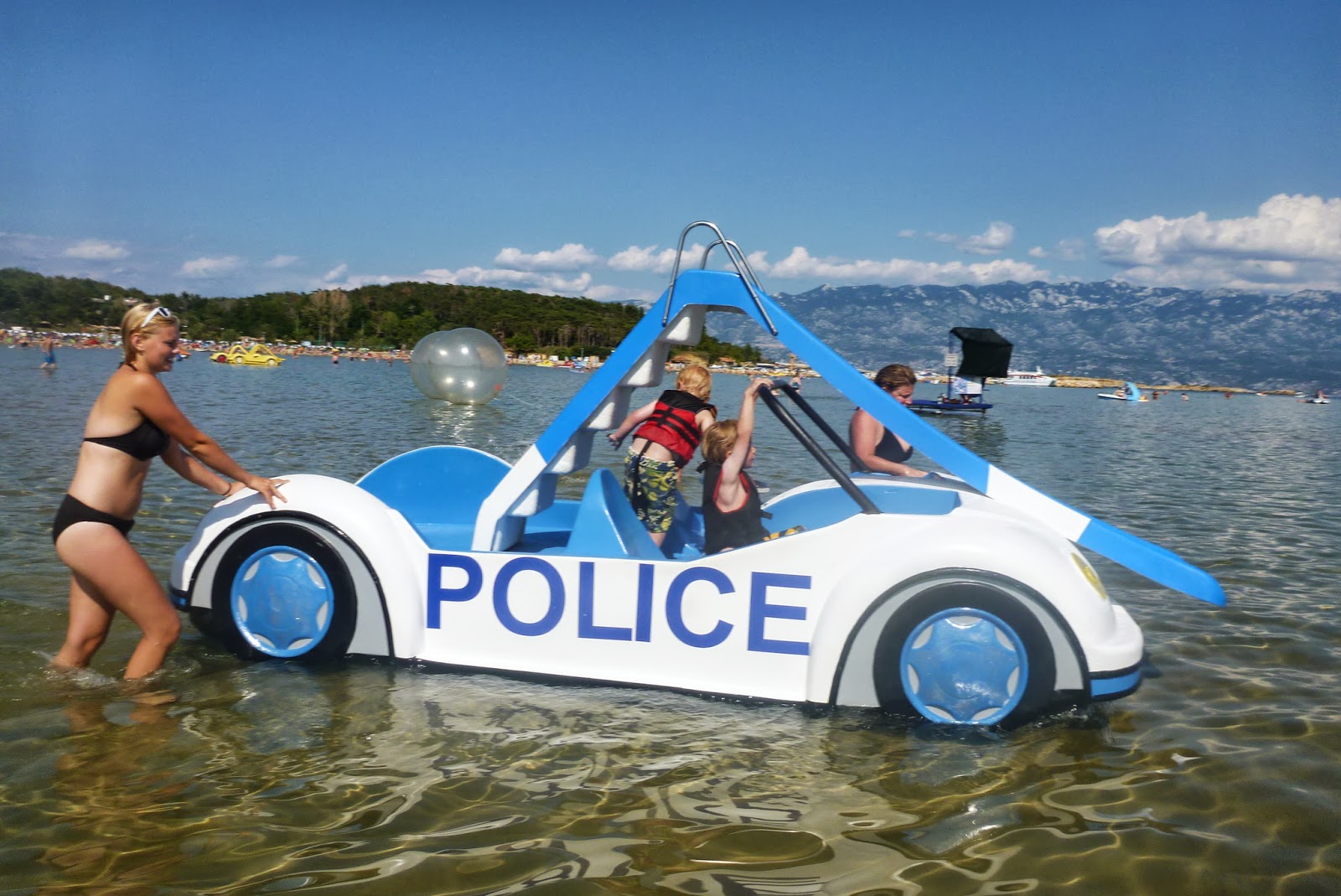
Needless to say, the scene was a hit with the kids.


... and the grown ups as well.


Other beaches were a bit more challenging to get to, requiring a boat trip and an epic portage to discover.


But the journey was well worth it.


The seemingly remove location brought us into close (well, not that close) contact with a flotilla of mostly Teutonic FKKers.   As mentioned previously, Rab is a hotbed of naturism, dating back to a visit from the soon-to-be ex-King Edward VII of Britain in 1936, who was apparently working on a major tan.  From our crowd, only Leo was sufficiently inspired by the King's example to go full FKK.


The rest of us were content to try our first Rapska torte and return in style to a resplendent Rab town.


Welcome to the Club! (Now, About Those Dues...)

Our visit to Rab fortuitously corresponded with Croatia's long-awaited ascension to full membership in the European Union, scheduled for the stroke of midnight on July 1.


Skeptics might ask, in light of the experience of Greece, Spain, and other Mediterranean countries, whether this was truly an occasion worth celebrating.  Or whether Croatia, only 20 years after fighting a bloody war to escape one uncomfortable federation, would really enjoy being part of another one.

But skeptics were not much in evidence in St. Christopher Square in Rab -- and presumably throughout the country -- where EU membership was being celebrated as a rite of passage for this relatively new nation.  

We were treated to a generous sampling of Croatian folk music and dancing, the raising of the EU flag to the "Ode to Joy" and--perhaps in a nod to the newly free flow of goods and services--an aging English rock band playing fairly enthusiastically received Yardbirds tunes.